
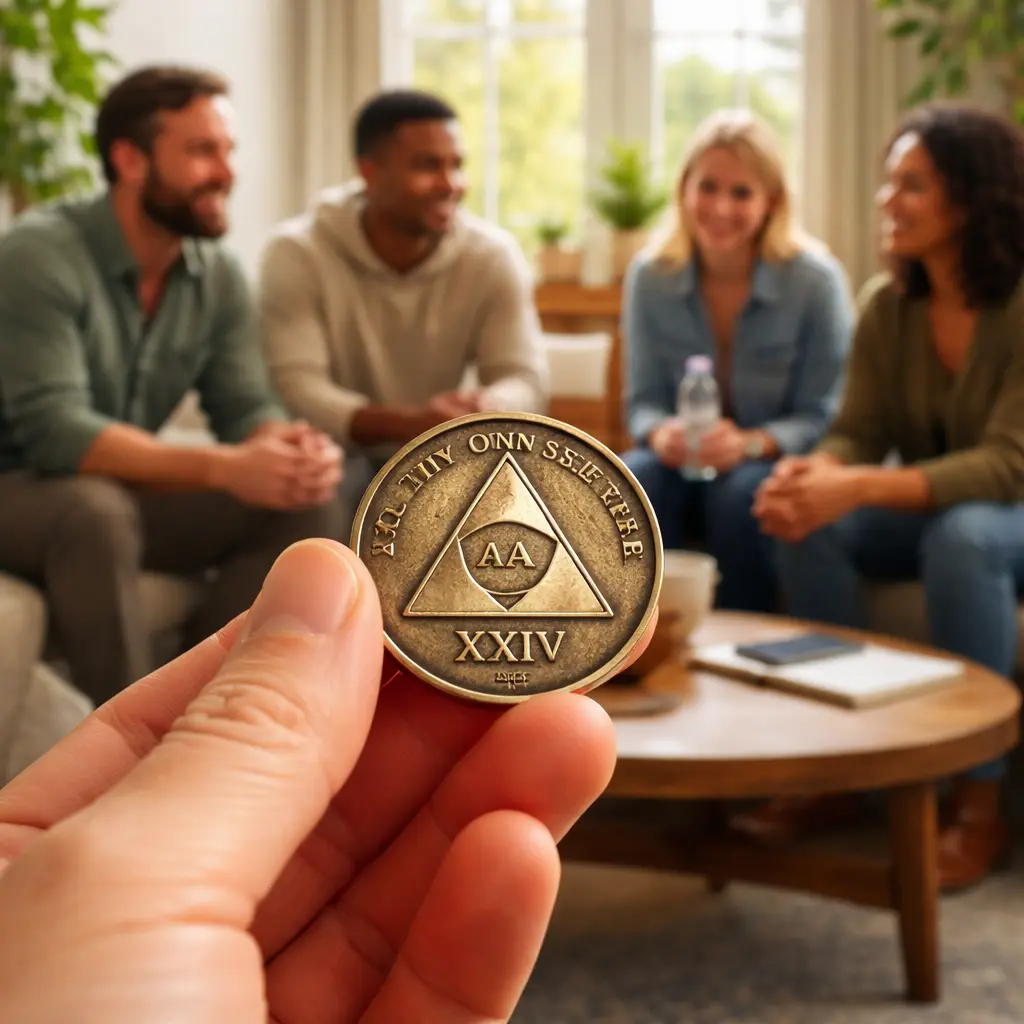

A unity service recovery coin is a type of recovery token used to mark progress in sobriety. You may hear it called a sobriety coin, medallion, or “AA chip.” The coin is not a medical tool and it is not a test of commitment. It is a small, physical reminder that many people find helpful as they build a stable routine and stay connected to support.
While designs vary, many of these coins include a circle-and-triangle symbol and the words “Unity, Service, Recovery.” Those three words are often treated as a short summary of what keeps a recovery program working: personal change, connection with others, and giving back.

Key Takeaways
- What the coin is — A unity service recovery coin is a recovery token used to recognize sobriety milestones and reinforce commitment.
- What the motto means — “Unity, Service, Recovery” reflects three supports many people use in sobriety: connection, helpful action, and personal change.
- Why the symbols matter — The circle-and-triangle design is commonly linked with Recovery, Unity, and Service as a quick visual reminder.
- How milestones are used — Coins can be given or carried to mark time sober, but the exact milestones and traditions vary by group.
- How to choose one — When buying or gifting a coin, consider privacy and whether personalization is welcome.
- How to use it daily — Many people turn the motto into a simple daily check-in: stay honest, stay connected, and be useful.
- When to seek extra help — If cravings rise or relapse risk increases, it’s safer to reach out for support than rely on a token alone.
- How Eudaimonia supports progress — A structured sober living setting can reinforce routines, accountability, and community connection tied to the coin’s meaning.
What is a Unity Service Recovery Coin?
A unity service recovery coin is a sobriety token that represents time or participation in a recovery journey. In many 12-step communities, coins are used to recognize milestones—anything from a first 24 hours to a full year and beyond. Sobriety coins are commonly described as tokens given to members to represent how long they have remained sober, and they are often made to be about the size of a poker chip.
If you want a broader overview of coins, chips, and milestone timing, use our sobriety coin guide.
How it relates to recovery tokens and milestones
Recovery tokens are simple objects with a clear purpose: they make an abstract goal feel tangible. A date on a calendar can be easy to ignore, but a coin in a pocket is hard to miss. For some people, that daily reminder supports consistency—showing up to meetings, calling a sponsor, and making choices that protect sobriety.
It also helps to remember what the token is not. A coin does not “make” recovery happen, and it does not replace a plan. Instead, it can function like a marker: “This matters to me, and I am still working on it.”
What you may see on the coin
A unity service recovery coin often includes a circle-and-triangle design that is commonly associated with AA-style recovery tokens. Many designs also include the phrase “To Thine Own Self Be True,” a time marker (days, months, or years), and the Serenity Prayer on the reverse side.
Not every coin includes every feature, and groups may use different formats. Still, repeated phrases and symbols show up often because they give the holder a quick way to remember core ideas without needing a long explanation.
Unity, Service, Recovery: What the words mean
The words on the coin are usually read as more than decoration. Many people link them to the “Three Legacies” concept: recovery, unity, and service. One AA source describes the circle as representing the whole world of A.A. and the triangle as representing A.A.’s three legacies—Recovery, Unity, and Service.
Recovery
In this setting, recovery means the personal work of changing behavior and building skills for sober living. That may include working the 12 steps, learning relapse prevention tools, addressing mental health needs, and repairing relationships where possible. It is also about honesty—recognizing triggers, taking responsibility, and asking for help before a small problem becomes a crisis.
Unity
Unity points to the role of community. Most people do not get better in isolation, especially when substance use has been tied to secrecy or shame. Unity is the idea that recovery is supported by connection: meetings, sponsorship, shared routines, and a sense of belonging. It also includes practical agreements that help groups function, such as respect for privacy and a focus on shared purpose.
If you’re looking for directories and options for ongoing connection, start with our recovery meetings resources.
NIAAA notes that people in recovery who attend mutual-support groups regularly tend to do better than those who do not (see Mutual support groups (NIAAA)).
Service
Service refers to giving back in ways that support others and reinforce your own stability. It can be formal, like helping run a meeting, or informal, like checking on a newcomer. The emphasis is not on status. It is on participation. Many people find that service creates structure, reduces self-focus, and strengthens accountability.
For a practical, plain-language explanation of service in a 12-step context, read our AA Step 12 explained guide.
The circle and triangle behind the motto
Many unity service recovery coins include a circle with a triangle inside it. In AA traditions, people often describe the circle as representing the whole fellowship, while the triangle represents recovery, unity, and service.
Why the shapes matter
Symbols are useful because they communicate quickly. A circle can suggest completeness and continuity. A triangle can suggest strength and balance, especially when its sides are equal. Some coin descriptions explain that an equilateral triangle represents equality among the three parts, while the circle represents the fellowship as a whole.
Is the symbol “official”?
It is common to see the circle-and-triangle on medallions and in recovery spaces, but its official status has changed over time. AA history sources describe trademark concerns and efforts to address unauthorized use, along with discussions at the General Service Conference about chips and medallions.
In the mid-1990s, AA conference history timelines show that leaders recommended discontinuing the circle and triangle logo on conference-approved literature.
Even with those changes, many local groups and individuals still use coins with the symbol as personal reminders. Practices vary by community, and many groups treat tokens as a local choice rather than a universal rule.
Eudaimonia's Success Stories – Real People, Real Freedom
EXCELLENTTrustindex verifies that the original source of the review is Google. Great staff, Eddie the property director is the bees knees! Eddie tells you like it is but shows empathy and compassion, while remaining form and kind!Posted on GoogleTrustindex verifies that the original source of the review is Google. Great people in a great placePosted on GoogleTrustindex verifies that the original source of the review is Google. Community of fellowship and directed house managers, firm,loving, and genuinely want you to succeed. Nice apts. As well laundry room free, pool, game room. Great price for recoveryPosted on GoogleTrustindex verifies that the original source of the review is Google. I am so grateful for Eudaimonia,it has changed my life for the best. I fall down but WE get up.
When and how these coins are used
A unity service recovery coin may be given out in a meeting, purchased as a replacement, or gifted to mark a milestone. There is no single universal rule. Many AA groups use chips or coins as reminders of progress and encouragement over time, including the use of different chips to represent different time ranges.
Common milestones people recognize
Milestones vary across groups, but the following are common in many recovery settings:
- 24 hours (often treated as a “start” marker)
- 30 days, 60 days, and 90 days
- 6 months and 9 months
- 1 year
- Yearly anniversaries after the first year
For a deeper breakdown of milestone timing in meetings, see our AA chips in order guide.
If you are unsure what your group uses, a simple approach is to ask after a meeting. Most groups will tell you their local practice, and many will emphasize that the point is encouragement rather than perfection.
What people do with a coin
People use these tokens in different ways. Some carry the coin daily. Others keep it at home and bring it out on difficult days. Some place coins in a visible spot as part of a morning routine. There is no “correct” method. The value of the coin is tied to the meaning you assign to it and the actions that follow.
What the coin does not mean
A coin is not a license to judge others. It is also not proof that someone has no struggles. Recovery is often uneven, and a person can hold a coin while still dealing with cravings, mental health symptoms, or stress. A neutral way to view the token is as a record of time and effort—not as a statement about worth.
Choosing, receiving, or gifting a Unity Service Recovery Coin
Some people receive a coin from a home group. Others buy one privately, especially if a coin was lost or if a specific design feels meaningful. AA history writing also reflects ongoing concerns about how recovery symbols can be used commercially, which is one reason the topic of medallions and symbols has been discussed over time.
Personalization and privacy
Engraved coins can feel special, but personalization can also raise privacy issues. Before adding a name, a date, or a message, consider whether the person would be comfortable with that information being visible. A neutral choice is a standard coin that focuses on the motto and the milestone.
Unity service recovery coin meaning in daily life
The unity service recovery coin meaning often becomes clearer with time. Early on, the coin may represent survival—getting through a day without using. Later, it may represent stability and responsibility. For many, the coin becomes a prompt to ask simple questions: Am I staying honest? Am I connected? Am I being useful?
A simple “three-part” check-in
When the words on the coin feel abstract, one practical approach is to translate each word into a small action. For recovery, that might mean attending a meeting, calling a support person, or avoiding a known trigger. For unity, it might mean staying connected to a sponsor or a peer group, especially during stressful weeks. While for service, it could be as simple as showing up early to help set up chairs or checking in with someone who is new.
This kind of check-in is not a test. It is a way to turn the motto into daily behavior.
When a token is not enough
Recovery tokens can be meaningful, but they are not a substitute for support. If cravings increase, relapse feels close, or mental health symptoms get worse, it can help to reach out early. Options may include talking with a sponsor, meeting with a licensed counselor, contacting a primary care clinician, or using a local crisis resource.
In the United States, SAMHSA’s National Helpline (1-800-662-HELP) is a free, confidential, 24/7 treatment referral and information service for individuals and families facing mental and/or substance use disorders.
If you need help finding treatment or support resources, SAMHSA’s National Helpline is a free, confidential, 24/7 referral and information service.
How Eudaimonia Recovery Homes Supports Unity, Service, and Recovery
Eudaimonia Recovery Homes can help people apply the meaning behind a Unity Service Recovery Coin in everyday life, not just in a meeting setting. In a structured sober living environment, residents can build routines that support the “recovery” part of the message, such as consistent schedules, meeting attendance, and follow-through on a personal plan.
House expectations and peer accountability can help keep milestones tied to real habits rather than only a date on a coin. Because “unity” is often strengthened through connection, Eudaimonia can support residents as they plug into community recovery meetings, practice healthy communication, and stay engaged with supportive peers. “Service” can also become practical and realistic through daily responsibilities in the home, helping others in small ways, and taking steps toward giving back when appropriate.
If someone is unsure what their coin represents in their specific program, Eudaimonia can encourage conversations with sponsors, meeting leaders, or trusted supports to align the symbol with personal goals. Over time, this kind of stable setting can make it easier to stay consistent with recovery tools and reminders, including tokens like sobriety coins. This support does not replace clinical treatment, but it can complement treatment by reinforcing stability, accountability, and ongoing participation in recovery.
Learn more about our structured sober living approach and how it supports daily recovery routines.
Other Sober Living Locations
Unity Service Recovery Coin FAQs
What is a unity service recovery coin?
A unity service recovery coin is a type of recovery token (often called a sobriety coin or AA chip) used to recognize time sober or a recovery milestone. Many designs include the words “Unity, Service, Recovery” and are used as personal reminders rather than official credentials.
What is the unity service recovery coin meaning?
The unity service recovery coin meaning is typically tied to three ideas that many people treat as support pillars: staying focused on recovery, staying connected to others (unity), and giving back in practical ways (service). The coin is meant to prompt reflection and consistency, not perfection.
What do “Unity, Service, Recovery” mean in recovery?
“Recovery” usually refers to personal change and day-to-day sobriety work. “Unity” points to connection with a group or supportive community, and “service” refers to helping others in ways that support healthy routines and accountability.
What does the AA circle and triangle symbol mean?
A common explanation is that the circle represents the whole fellowship, and the triangle represents the three legacies: Recovery, Unity, and Service. You may see this symbol on many coins and medallions, even though its official use in AA materials has changed over time.
Are sobriety coins and AA chips the same thing?
Often, yes. Many people use “sobriety coin,” “AA chip,” “recovery token,” and “medallion” to mean the same general item, even though the materials can differ (plastic chips vs. metal coins)
Is there an official AA coin or medallion?
AA does not issue an official, universal sobriety coin for all groups. In addition, AA’s General Service Office states it does not produce, distribute, or sell chips/coins/medallions through aa.org.
Does AA sell chips, coins, or medallions on aa.org?
No. AA’s official FAQ states that neither GSO nor A.A. produces, distributes, or sells sobriety tokens like chips, coins, or medallions on aa.org.
How do sobriety coins work in AA meetings?
In many meetings, chips or coins are offered during a brief recognition moment for people who want them, usually based on time sober (such as 24 hours, 30 days, or annual anniversaries). Exact timing and traditions vary by group, so it is normal to see differences from one meeting to another.
What are common AA chip milestones?
Common milestones often include 24 hours, 30 days, 60 days, 90 days, 6 months, 9 months, and 1 year, with yearly recognition after that in many groups. Some groups use different colors or sequences, so it helps to confirm local practice.
What does “To Thine Own Self Be True” mean on a recovery coin?
This phrase appears on many sobriety coins as a short reminder about honesty and staying aligned with personal values. People often interpret it as a prompt to make choices that match their recovery goals, especially during stressful moments.
Why do many sobriety coins include the Serenity Prayer?
Many medallions include the Serenity Prayer on the reverse side as a familiar reminder used in many recovery settings. The presence and exact wording can vary by coin design and manufacturer.
Can you buy a sobriety coin, or do you have to receive one?
Some people receive coins through meetings or as gifts, while others purchase replacements or milestone coins from retailers. The key point is that AA itself does not sell sobriety tokens through its official channels.


